Lincolnshire Police HQ Memorial Garden: Reimagining Sacred and Civic Space
Lincolnshire Police HQ Memorial Garden: Reimagining Sacred and Civic Space
In contemporary landscape architecture, designing memorial infrastructure requires reconciling a fundamental spatial paradox: how to construct an intimate, sacred sanctuary for personal grief while simultaneously providing a permeable, resilient setting for public civic ritual and institutional identity. The Lincolnshire Police Headquarter Memorial Garden, designed by epd Landscape, addresses this balance through strategic spatial relocation and theoretical rigor. Historically, the force’s existing memorial occupied an isolated position behind secure perimeter gates at the rear of the main headquarters building. Access was heavily restricted, requiring visitors to schedule advance appointments and remain escorted by security personnel at all times. This physical and operational barrier effectively detached the site of remembrance from the broader public and from the daily routines of serving officers.
Lincolnshire Police HQ Memorial Garden: Reimagining Sacred and Civic Space
The new design intervention relocates the memorial to a prominent 4,049.85 m² green pocket situated across the main internal access road. By converting a neglected, uneven expanse of rabbit-burrowed lawn into a publicly accessible circular sanctuary, the intervention redefines the police memorial typology. It transitions from a fortified, defensive enclave into an open, democratic landscape of active remembrance and solitude. By taking advantage of natural sightlines and existing site surveillance coverage, the project successfully establishes open public access without compromising the security threshold of police headquarters.
Proportional Geometry, Ethos, and Civic Ceremony
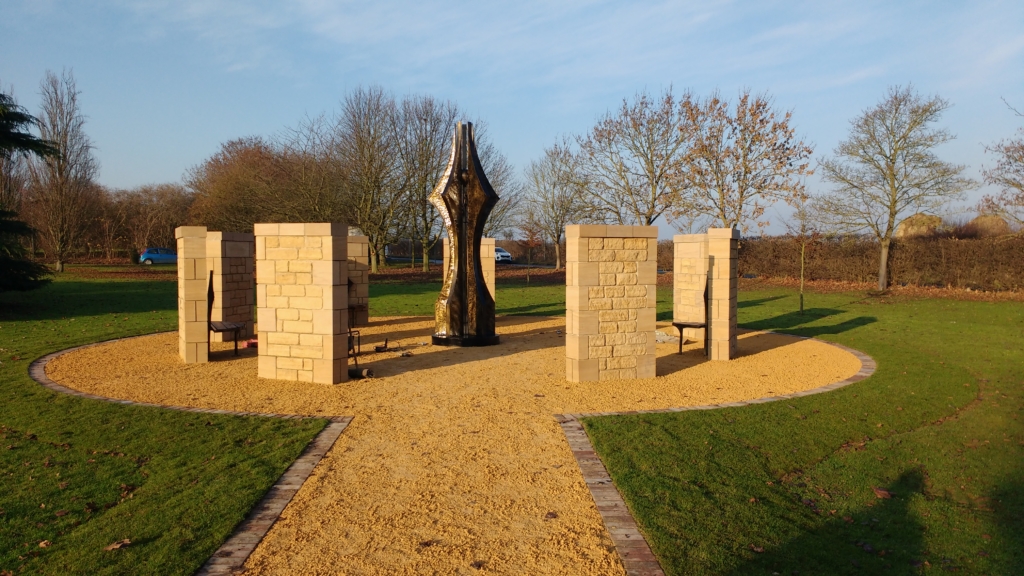
The visual and spatial syntax of the garden draws deeply upon classical sacred geometry and institutional history. The master plan adopts the Golden Ratio (1:1.618) as its guiding structural framework. Enclosing the central gathering space are nine distinct shelter walls constructed from locally quarried stone masonry, measuring 1.2 meters in width by 1.9 meters in height. These proportional parameters create an enclosure that feels subliminally balanced, providing visitors with a grounded sense of quiet order and visual protection from the surrounding road network.
The nine walls explicitly symbolize Sir Robert Peel’s foundational principles of modern democratic policing. Each masonry structure is inscribed on its interior surface with a single simplified core value—including Integrity, Humility, Prevention, Impartiality, and Cooperation. Paired with timber seating integrated directly into the base of each wall, the architecture transforms passive resting places into active points of individual reflection.
At the geometric and symbolic center stands a bespoke steel sculpture designed and fabricated by artist blacksmith Graeme Hopper following consultations with force leadership. Formed from galvanized steel finished with a subtle dark lacquer, the sculpture features vertical elements reaching upward to grasp and elevate human truth, fairness, and ethics above all else. The wide, self-binding aggregate paths radiating from this central focus accommodate both formal ceremonial parades—such as ribbon cutting dedications, honor guards, and wreath-layings—and solitary visits.
Material Ecology and Plant Palette
The material choices ground the intervention firmly within its regional context and natural ecosystem:
• Local Stone & Sourced Aggregate: The wall masonry and crushed Bredon gravel pathways draw directly from regional geological sources, embedding the project into Lincolnshire’s material fabric while minimizing embodied carbon emissions.
• The Evergreen Honor Guard: A formal ring of 21 indigenous European Yew trees (Taxus baccata) surrounds the central feature, symbolizing the centuries of the Gregorian calendar while serving as a living guard of honor that frames the approach.
• Resilient Understory: Ground planting relies on aromatic English Lavender (Lavandula angustifolia), selected for its resilience against local rabbit populations, seasonal color contrast, and ecological benefits for native pollinators.
• Sustainable Illumination: Solar-powered path lighting defines the outer perimeter at dusk, offering subtle ambient security
By pairing spatial proportion with local craftsmanship, ecological resilience, and democratic public access, the Lincolnshire Police HQ Memorial Garden provides a meaningful model for modern civic landscape architecture.
For the latest industry news visit landscapingmatters.co.uk/news
Get all of the big headlines, pictures, opinions and videos on stories that matter to you.
Follow us on Twitter and Instagram for fun, fresh and engaging content.
You can also find us on Facebook for more of your must-see news, features, videos and pictures from Landscaping Matters