The Hidden Risk in Decking Specification
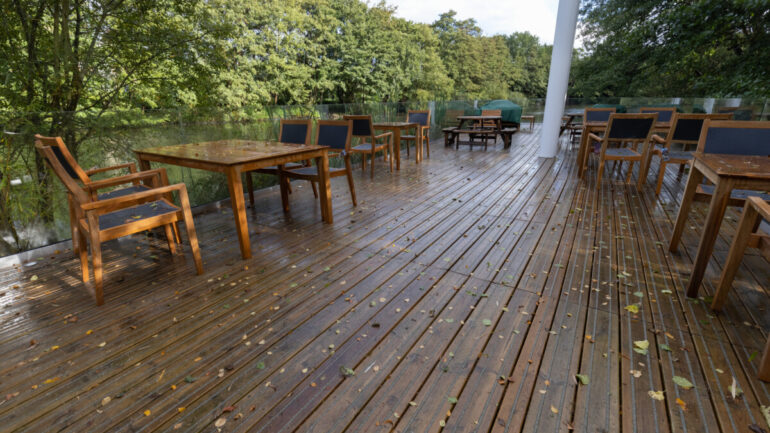
The Hidden Risk in Decking Specification: Across the UK, decking has become a defining feature of contemporary landscape architecture—integrating seamlessly into parks, waterfronts, education settings, hospitality venues and public realm schemes. It is often valued for its aesthetics, sustainability credentials and ability to create warm, inviting outdoor spaces. Yet behind the visual appeal lies a persistent and under-acknowledged problem: the industry continues to accept decking systems whose real-world slip resistance has not been proven to be safe in the conditions in which they will actually be used.
Slips and falls remain one of the most common causes of major injury in public and workplace environments. Rainfall, shade, biological growth, moisture retention and high footfall all increase the likelihood of incidents, and these are precisely the conditions in which landscape decking is routinely installed. Despite this, many specifications still rely on generic “anti-slip” claims, dry-condition test data, or ratings that have limited relevance to UK public-realm use. For a profession that emphasises evidence-based design, this gap between expectation and reality is increasingly difficult to justify.
The Hidden Risk in Decking Specification
What Safe Performance Should Mean
The preferred method in the UK for assessing pedestrian slip resistance is the pendulum test, which provides a Pendulum Test Value (PTV). For surfaces exposed to wet conditions—common across almost all outdoor landscape applications—a wet PTV of 36 or above is typically understood to indicate low slip risk. In many situations, especially high-traffic or high-vulnerability environments, a more conservative threshold is appropriate.
However, too many specifications are underpinned by incomplete or inappropriate data. R-ratings generated from ramp tests continue to appear in marketing literature, yet these tests were designed for industrial environments with controlled footwear and do not reliably represent typical footwear or public use. Likewise, dry-condition data is often emphasised even though the surface will be wet for much of the year. In some cases, suppliers simply offer no meaningful test information at all. Without verified wet-pendulum results from an accredited testing body, specifiers are effectively being asked to take safety on trust.
The Professional, Ethical and Legal Implications
Landscape and urban design professionals increasingly operate under heightened expectations regarding safety, inclusivity and accountability. When a decking surface becomes slippery after the first winter, users do not distinguish between product, contractor and designer; they simply recognise a failure of the environment to meet their needs. For clients in education, leisure, local government and healthcare—where vulnerable users are common—such failures can have significant implications.
From a legal and compliance perspective, designers and asset owners are expected to demonstrate that they have reduced foreseeable risks “as low as reasonably practicable.” If a surface is known to be at risk of becoming slippery when wet, and more robust alternatives exist, it becomes difficult to defend the specification of a system without verifiable performance evidence. In short, the absence of reliable test data becomes a liability.
Climatic and Demographic Pressures
Climate patterns are shifting, bringing more prolonged damp conditions, more intense rainfall and greater variability in seasonal contaminants such as algae, leaf litter and pollution films. These changes make real-world slip performance more critical than ever. At the same time, public spaces are being designed for increasingly diverse and ageing user groups. Older people, children and individuals with mobility impairments are more susceptible to slips and more likely to suffer serious consequences. A decking surface that becomes hazardous in predictable conditions is incompatible with modern expectations of accessibility and inclusive design.
Performance-Led Specification: A More Rigorous Approach
To achieve robust and predictable safety outcomes, landscape professionals may wish to adopt a more structured approach to decking specification:
- Set a clear minimum performance requirement. For wet-exposed environments, a wet PTV of at least 36 should be considered the baseline, with higher targets applied in areas of heavy use, contamination or increased vulnerability.
- Require independent, up-to-date test reports. These should be conducted in accordance with current recognised standards, clearly stating test conditions, direction of travel and the sliders used.
- Consider contamination profiles. Decks beneath trees, adjacent to water, shaded by structures or subject to organic debris will not behave like clean, evenly exposed test samples. Systems should be evaluated for their ability to maintain performance in realistic conditions, not just ideal ones.
- Evaluate the longevity of slip resistance. Some systems rely on surface textures that polish, wear or clog over time. Others incorporate abrasive elements designed to offer longer-term stability. Understanding how a system performs after years of exposure is as important as knowing how it performs when new.
- Align maintenance expectations with client capability. Slip resistance should not depend on unrealistic cleaning regimes. If specialised or frequent maintenance is required, this must be part of the design dialogue.
How Product Choice Influences Outcomes
Materials and manufacturing methods have a profound effect on slip behaviour. Timber decking incorporating high-friction inserts can deliver consistently high wet PTV values when engineered correctly. High-density bamboo and certain composite boards can also perform well, but only when slip resistance is a central design consideration rather than a late-stage enhancement. The market contains products that vary widely in performance, making rigorous evaluation essential.
A Call for Professional Consistency
Landscape architecture has matured significantly in its approach to sustainability, drainage, lighting, accessibility and biodiversity. Slip resistance deserves the same level of professional discipline. Designers are not expected to accept vague structural claims, unverified environmental data or unsupported product lifespan assertions—yet the industry continues to tolerate imprecise information on a parameter that directly affects user safety.
The profession has an opportunity to lead by insisting on verified, transparent and independently tested slip-resistance data as a standard requirement. Doing so will not constrain creativity; rather, it will ensure that beautiful public spaces remain safe, inclusive and reliable long after installation.
For the latest industry news visit landscapingmatters.co.uk/news
Get all of the big headlines, pictures, opinions and videos on stories that matter to you.
Follow us on Twitter and Instagram for fun, fresh and engaging content.
You can also find us on Facebook for more of your must-see news, features, videos and pictures from Landscaping Matters